Autismand attention deficit hyperactivity disorder (ADHD) are two distinct neurodevelopmental conditions that are often believed to commonly co-occur together.
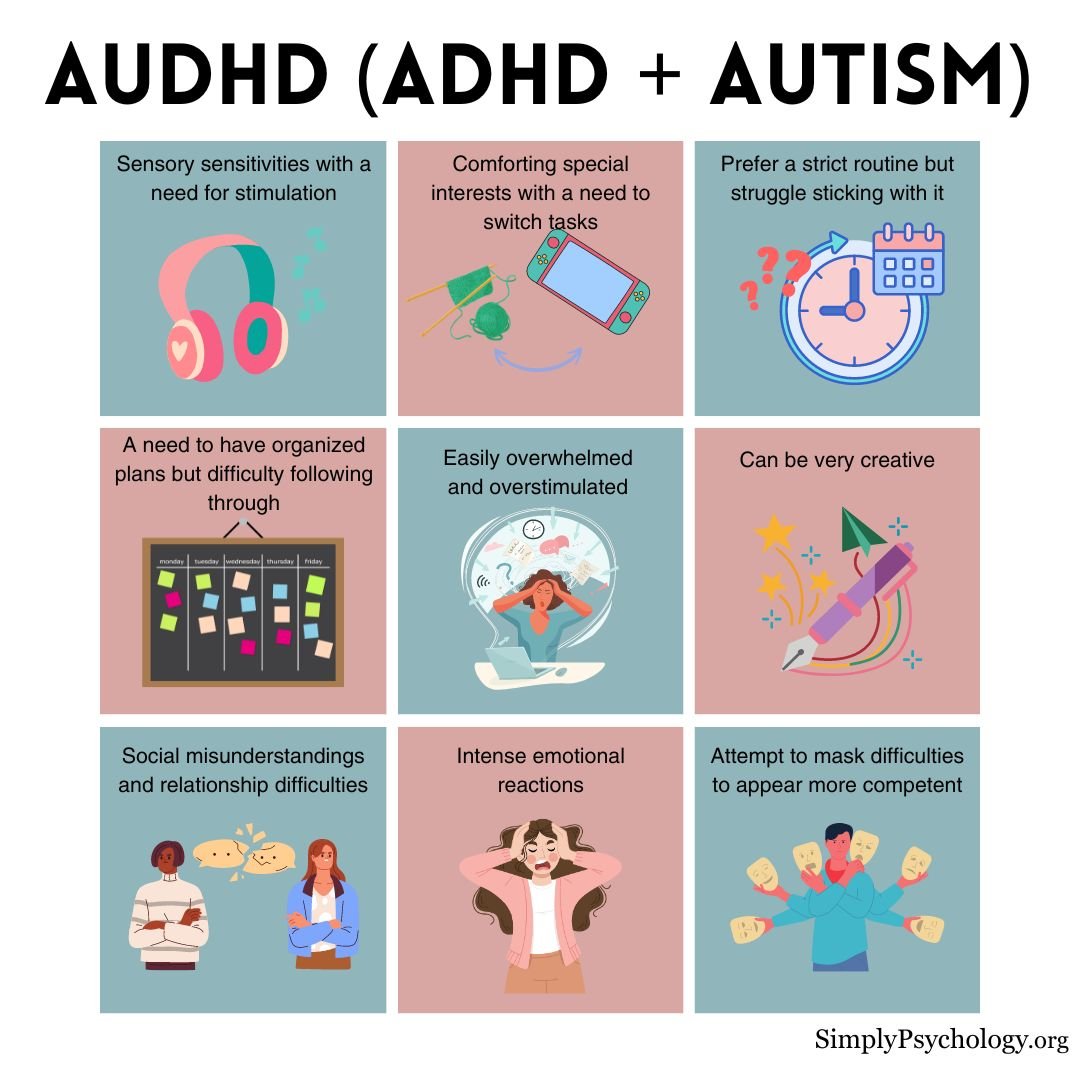
AuDHD (combining the terms autism and ADHD) is an unofficial but more commonly used term to refer to individuals who are both autistic and have ADHD. Since AuDHD is not an official diagnosis, individuals will have separatediagnoses of autismand ADHD.
“In my experience, having autism and ADHD is like having a wife and a mistress, although I’m not always sure which is which as they can be subject to change, rivalry and the odd spat.
How common is AuDHD?
AuDHD may be more common than was originally believed. It is unclear precisely how common it is, butscientific literature suggests50-70% of autistic individuals may have co-occurring ADHD.
Dr. Debra Bercovicifrom Embrace Autism explains that despite high co-occurrence rates, it was believed (prior to 2013) that autism and ADHD could not co-occur as they were viewed as being contradicting conditions. Therefore, research predating this may not account for this overlap, and our understanding of this overlap is limited.
This may mean that there are many autistic individuals who do not realize they also have ADHD and vice versa. It is important to recognize the co-occurrence of autism and ADHD so that individuals can have a better understanding of themselves and to ensure they receive specific support that is tailored to their unique traits.
Overlapping Autism and ADHD Traits
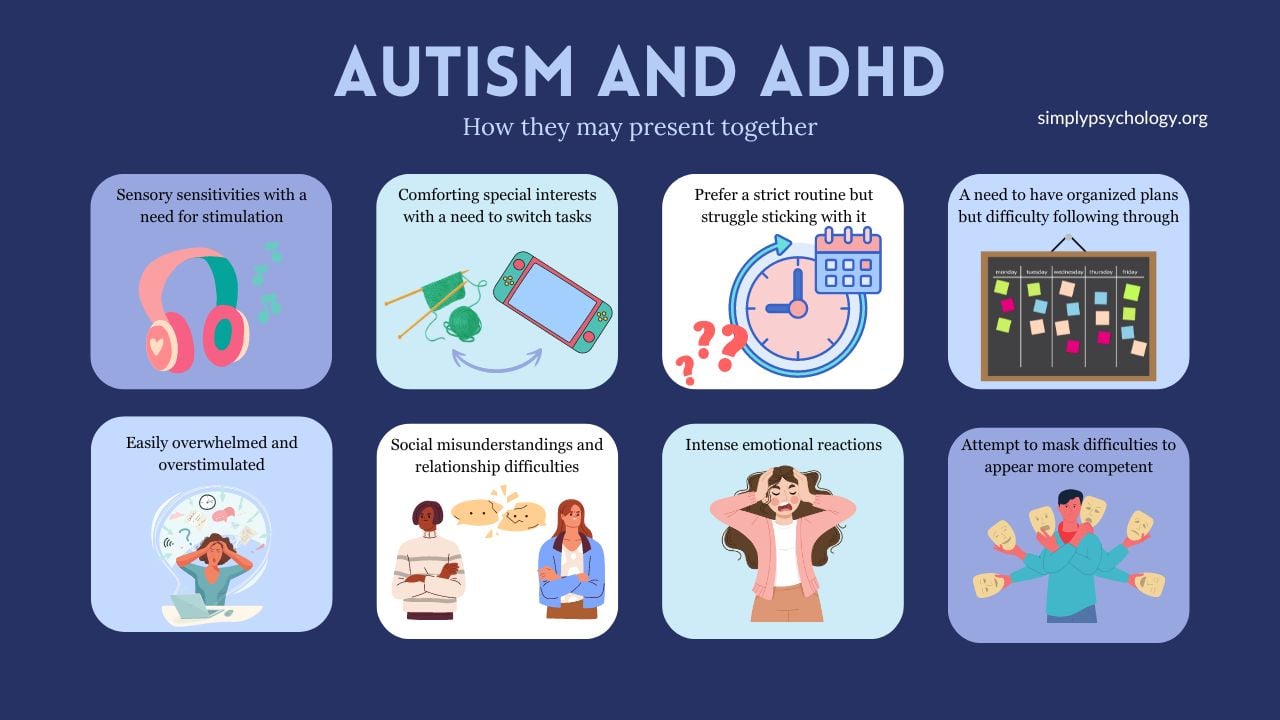
Below are some of the ways in which autism and ADHD can overlap. It is important to recognize that the presentation of autism and ADHD can vary widely among individuals, and not everyone will have the same experiences.
Attentional differences
According to research, both autistic individuals and those with ADHD may experience difficulties with sustaining attention, shifting focus, and disengaging from stimuli.
AuDHDers may:
Executive functioning challenges
Autism and ADHD are associated withdifficulties in organization, time management, planning, and cognitive flexibility.
Sensory processing differences
Individuals who are autistic and have ADHD may experience hyper- or hypo-reactivity to sensory input as well as racing thoughts, leading to feelings of overwhelm or distress.
Social difficulties
While the nature of social difficulties may differ,both autistic individuals and those with ADHDcan struggle with social interactions, understanding social cues, and adjusting behavior to suit various social contexts.
Emotion regulation differences
Autistic individuals and those with ADHD may experiencechallenges with emotional regulation, leading to intense or impulsive emotional reactions.
Neurodivergent masking
Masking(or camouflaging) refers to hiding or suppressing traits of neurodivergence as a way to appear neurotypical and ‘fit in.’ Masking is commonin autistic individualsas well asthose with ADHD.
An AuDHDer may:
What does it feel like to be both autistic and have ADHD?
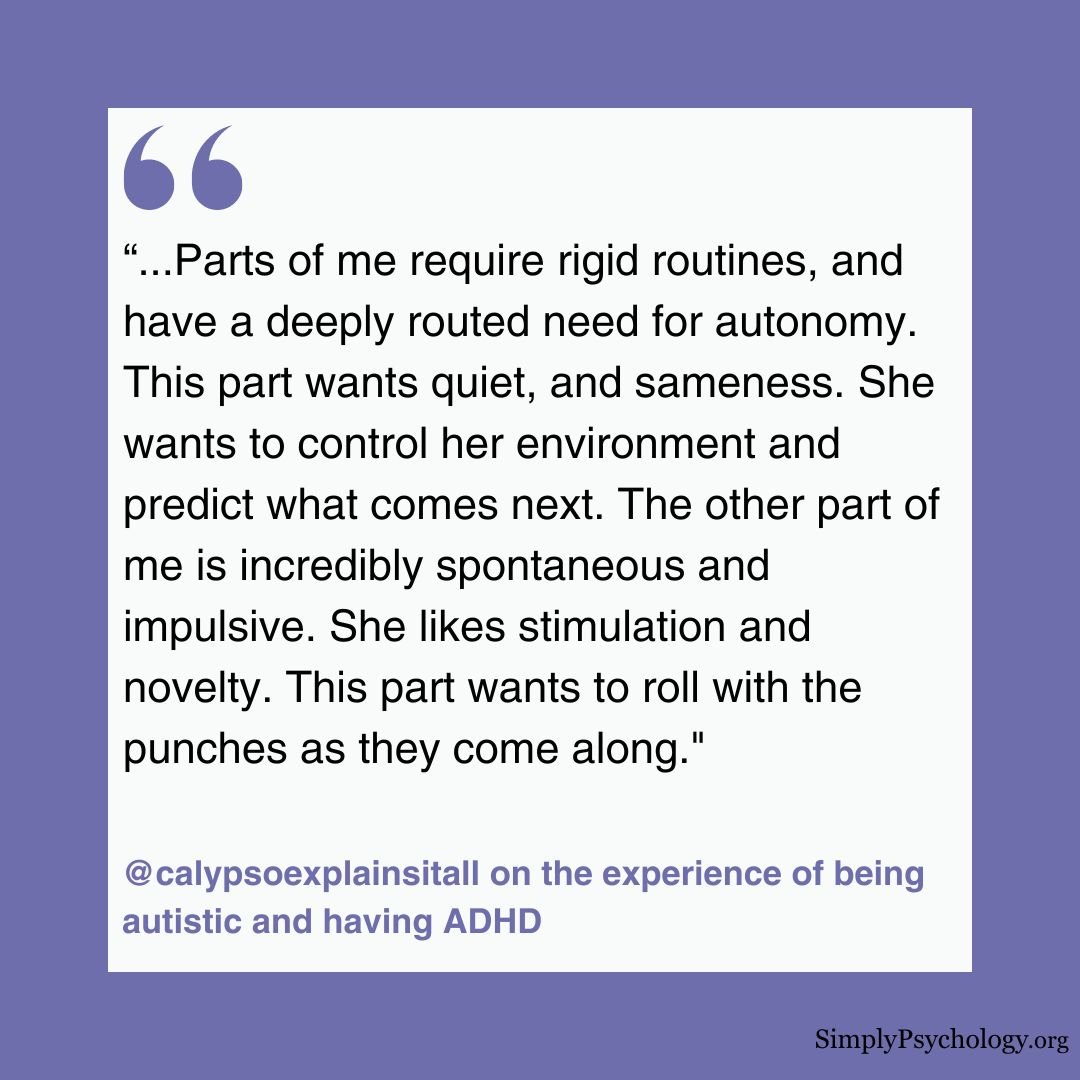
For some individuals with AuDHD, the co-occurrence of autism and ADHD can feel like having two opposing forces within oneself.
I spoke to one individual who described her experience with navigating her internal conflicts:
I also spoke toThe Autistic Lawyer, who shared an extract from her book: “Smelling the Taste of Sound” to elaborate on this internal dynamic when approaching tasks:
For individuals with AuDHD, the demands of parenting and family life can be particularly challenging. The added responsibilities and lack of structure can exacerbate existing difficulties, leading to feelings of overwhelm and frustration.
Calypso (@calypsoexplainsitall) explained to me that she came to realize she is both autistic and an ADHDer after becoming a parent. She shares:
For some individuals, receiving an AuDHD diagnosis for themselves or their child can be a turning point in understanding their challenges and recognizing patterns within the family.
Individuals with AuDHD may also describe difficulties with impulse control and disorganized thinking associated with ADHD, paired with more rigid, detail-oriented forces from autism.
The Autistic Lawyerexplains in her book how this can feel:
So while ADHD provides energy and impulsivity, autism can act as a counterbalance, providing structure and caution. There can, therefore, be value in co-occurring autism and ADHD as they can work together to create a more balanced and effective way of navigating life.

How do I know if I have AuDHD?
If you suspect that you may have AuDHD, it is essential to seek a comprehensive evaluation from a qualified healthcare professional. However, reflecting on your experiences and traits can be a helpful starting point.
Consider the following questions:
If you find yourself answering “yes” to many of these questions and relating to the experiences of others with AuDHD, it may be worth pursuing a formal evaluation.
References
Carter Leno, V., Chandler, S., White, P.et al.Testing the specificity of executive functioning impairments in adolescents with ADHD, ODD/CD and ASD.Eur Child Adolesc Psychiatry27, 899–908 (2018).https://doi.org/10.1007/s00787-017-1089-5
Hours, C., Recasens, C., & Baleyte, J. M. (2022). ASD and ADHD comorbidity: What are we talking about?.Frontiers in psychiatry,13, 837424.https://doi.org/10.3389/fpsyt.2022.837424
Rau, S., Skapek, M. F., Tiplady, K., Seese, S., Burns, A., Armour, A. C., & Kenworthy, L. (2020). Identifying comorbid ADHD in autism: Attending to the inattentive presentation.Research in Autism Spectrum Disorders,69, 101468.https://doi.org/10.1016/j.rasd.2019.101468
Van Der Meer, J. M., Oerlemans, A. M., Van Steijn, D. J., Lappenschaar, M. G., De Sonneville, L. M., Buitelaar, J. K., & Rommelse, N. N. (2012). Are autism spectrum disorder and attention-deficit/hyperactivity disorder different manifestations of one overarching disorder? Cognitive and symptom evidence from a clinical and population-based sample.Journal of the American Academy of Child & Adolescent Psychiatry,51(11), 1160-1172.https://doi.org/10.1016/j.jaac.2012.08.024

Saul McLeod, PhD
BSc (Hons) Psychology, MRes, PhD, University of Manchester
Saul McLeod, PhD., is a qualified psychology teacher with over 18 years of experience in further and higher education. He has been published in peer-reviewed journals, including the Journal of Clinical Psychology.
Olivia Guy-Evans, MSc
BSc (Hons) Psychology, MSc Psychology of Education
Olivia Guy-Evans is a writer and associate editor for Simply Psychology. She has previously worked in healthcare and educational sectors.
