Anxiety disorderscan affect anyone regardless of gender, but they are common in women for a variety of reasons.
Hormonal fluctuations during menstrual cycles, pregnancy, and menopause can significantly impact anxiety levels, making anxiety conditions more common and often more severe in women.
Additionally, women have greater social pressures related to appearance, career, and family roles, which contribute to heightened stress and anxiety.
The many interconnected factors contributing to anxiety in women include hormonal fluctuations, societal pressures, biological differences, and life experiences. Understanding these diverse influences can help in addressing and managing anxiety more effectively.
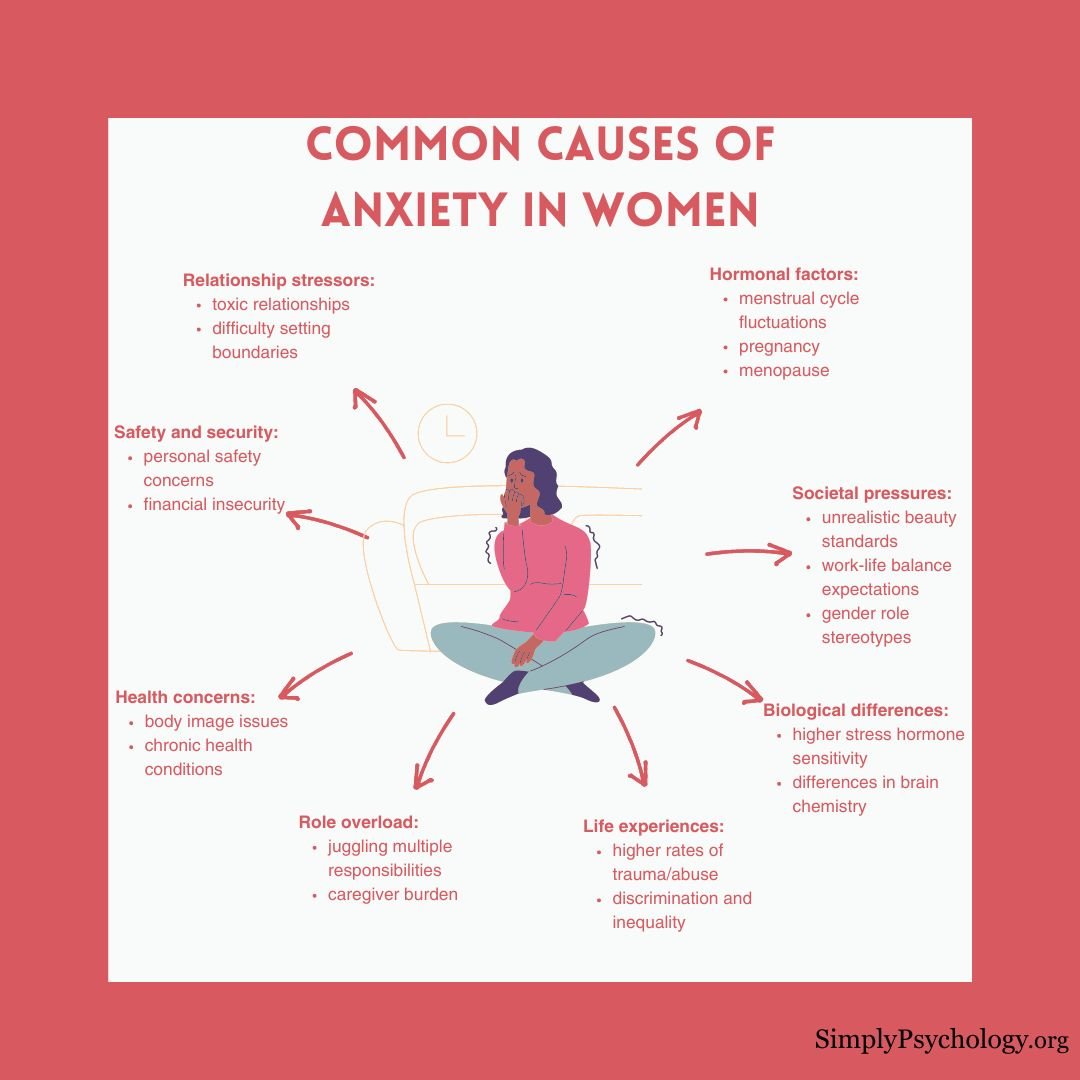
Recognizing the factors that cause anxiety in women is the first step in learning to manage and overcome these challenges, ensuring that individuals and healthcare providers can develop targeted and effective strategies forprevention and treatment.
Signs of anxiety in women
While women can experience all the usual signs of anxiety disorders such as rumination, excessive worry, and physical signs (e.g., sweating, heart racing, and shaking), there can be specific anxiety-related signs that can be more common in women.
How anxiety may manifest in women:
Women are more likely to:
Signs of perinatal anxiety, which can affect women in pregnancy and postpartum:
Is Anxiety More Common In Women Than Men?
Anxiety disorders are more prevalent in women,affecting around twice as many women as men. This higher prevalence is attributed to a complex interplay of biological, hormonal, and sociocultural factors.
Women are more likely to be diagnosed with generalized anxiety disorder (GAD), panic disorder, and specific phobias.
Research has foundthat “anxiety disorders (are) associated with a greater illness burden in women than in men…suggest(ing) that anxiety disorders are not only more prevalent but also more disabling in women than in men.”
Other research suggeststhat found that women display “greater illness severity and functional impairment.”
Bigalke et al. (2020)found that “women (80.3%) reported higher prevalence of increased general anxiety due to COVID-19 when compared to men.”
Fawcett et al. (2020)found that “women are typically at greater risk of experiencing OCD in their lifetime than men.”
Anxiety is more common in women due to a combination of biological, hormonal, and sociocultural factors.
Around 30% ofanxiety issues are linked to genetics, making women with anxious parents more vulnerable. The remaining 70% stems from environmental influences, such as life experiences and learning anxious behaviors from caregivers.
A systematic review, including 44 studies, found that “masculinity may be a protective factor for anxiety development, while femininity can be a risk factor.”
“The potential influence of brain structures, genetic factors, and fluctuations in sexual hormones are…causes of greater anxiety in women.”
Women also tend to be more attuned to their emotions and may be more likely to seek help or discuss anxiety compared to men, and thus receive a diagnosis.
What can cause anxiety in women?
Below are some of the possible reasons why anxiety is so common in women:
Societal Pressures and Unrealistic Expectations
Socioculturally, women face higher expectations and pressures related to their roles in family, work, and society.
Moreover, women are expected to conform to societal standards of appearance and behavior, leading to pressure to meet unrealistic beauty ideals and societal expectations. This can heighten anxiety, body image, and self-esteem issues.
Hormonal Differences
Biologically, women are more sensitive to stress hormones like cortisol, which can trigger anxiety.
Furthermore, hormonal fluctuations throughout a woman’s life cycle, from puberty to pregnancy and menopause, can influence brain chemistry and affect anxiety levels.
Premenstrual Syndrome (PMS), perimenopause, and menopause involve hormonal fluctuations that can cause anxiety increases. Thyroid issues can disrupt mood regulation, while postpartum anxiety and Polycystic Ovary Syndrome (PCOS) contribute to anxiety through complex hormonal imbalances.
Use of contraceptives
Research and anecdotal evidence suggest that some women experience heightened anxiety when taking the pill.
Perinatal and postnatal issues
Laura Hans is a Pregnancy, Postpartum and Motherhood Psychotherapist.
She explains that “during theperinatal period, and even afterwards, birthing people and their partners/carers of the child are vulnerable to experiencing mental ill health, partly because pregnancy can be a worrying time but also because of the many changes that occur physically, emotionally, and practically.”
“The perinatal period is the time that we are most vulnerable to the development of anxiety…than any other time in our lives.”
Furthermore,birth traumamay also present as anxiety, andhealth anxietycan occur during pregnancy and after birth.
The constant need to excel and meet high standards in appearance, career, and relationships can lead to perfectionism, stress, anxiety, and a sense of never being “good enough.”
This relentless pursuit of societal approval often leads to feelings of inadequacy in women, especially when comparing themselves to others online or in person.
Motherhood
Motherhood can trigger anxiety in many women due to the profound identity shift and lifestyle changes it entails.
The transition from an independent individual to a primary caregiver often challenges a woman’s sense of self and autonomy.
Many new mothers struggle with the loss of personal time, career disruptions, and changes in social dynamics.
Additionally, societal expectations of the “perfect mother” can create pressure to excel in this new role while maintaining pre-motherhood standards in other areas of life.
This balancing act, combined with sleep deprivation and physical recovery, can leave many women feeling overwhelmed and anxious as they navigate the complex emotional landscape of early motherhood.
The stark contrast between pre- and post-motherhood life often contributes to a sense of loss and uncertainty, further fueling anxiety.
Role Overload
Women are more likely to juggle multiple responsibilities, such as caring for children and elderly family members while maintaining full-time jobs and handling the often unequal burden of household chores.
The constant struggle to balance work, family, and home life can be a major anxiety trigger for women.
Without strong time management skills and clear work-life boundaries, this pressure can cause overwhelming anxiety.
Safety Concerns
Real or perceived threats of violence, harassment, or assault, even within relationships, can be debilitating.
Lack of safe spaces in one’s area, especially at night can put women in a constant state of vulnerability.
Women are also more likely to experience trauma, such as sexual abuse or domestic violence, which is a risk factor for mental health issues.
Additionally, financial dependence on others or social isolation can amplify safety anxieties and decrease a woman’s sense of security.
Toxic Relationships
Abusive partners, critical family members, or unhealthy/draining friendships can cause persistent anxiety.
Women are often more likely to stay in toxic romantic relationships due to societal expectations, cultural pressures, financial dependency, low self-esteem, and emotional manipulation.
Economic Stress and Financial Insecurity
Women are more susceptible to low socio-economic status and lack of power. Thus, financial anxieties can weigh heavily on women.
Concerns about economic security, managing debt, affording basic needs, or meeting household financial obligations can be a source of stress, especially for single mothers.
Workplace Discrimination and Inequality
Facing discrimination and inequality at work includes:
This environment can undermine confidence, cause job insecurity, and obstruct professional growth.
Childhood Trauma
Research suggests that“women may be more vulnerable to the influence of childhood trauma.”
Childhood trauma and early adversity can impact brain development and coping mechanisms.
Systematic reviewshave found that childhood trauma “impacts the functioning of the brain, mind, and body,” and isstrongly linked to mental illnessin adulthood.
Inflammation
Inflammation is more common in women due to hormonal differences and autoimmune disorders. Conditions involving chronic inflammation, like fibromyalgia, are more prevalent in women.
Clinical and translational neuroimaging researchhas demonstrated that acute and chronic inflammation affects brain regions related to threat sensitivity, which enhances anxiety symptoms.
Anxiety in women from ethnic minority groups
In addition to gender-based expectations, women of color experience societal pressures and anxieties related to race and ethnicity.
Women from ethnic minority groups can experience anxiety due to stressors such as discrimination, cultural expectations, and socioeconomic disparities.
They also may face heightened pressure to conform to both their cultural norms and broader societal standards, leading to role overload.
Barriers preventing women from seeking help and receiving effectivetreatmentinclude:
This combination of factors can create a complex, intensified, and unique experience of anxiety for ethnic minority women.
Such barriers mean anxiety issues can remain untreated or only addressed once the person has reached breaking point and symptoms have become very severe.
Anxiety triggers for minority-ethnic women:
Researchfound that “one third of the Black people surveyed reported clinically significant anxiety symptoms.” Additionally, “increasing levels of racial discrimination and microaggressions were associated with higher rates of anxiety.”
Researchincluding Muslim college students concluded that perceived discrimination leads to anxiety symptoms through acculturative stress.
Furthermore,Watson and Hunter (2015)explained that “The Strong Black Woman (SBW) race–gender schema prompts African American women to use self-reliance and self-silence as coping strategies in response to stressors.”
Their findings suggested that “utilizing the coping strategies associated with the SBW race–gender schema could trigger anxiety…that may intensify when coupled with negative attitudes toward professional psychological help.”
How to manage anxiety as a woman
Menstrual Cycle Tracking and Hormonal Health Checks
Many women experience heightened anxiety before and during their menstrual periods due to changes in hormone levels.
Understanding and tracking your menstrual cycle helps predict and manage anxiety linked to hormonal fluctuations.
Community Building
Women are wired for connection and often find strength in community. Expressing your emotions and building friendships can be powerful stress management tools.
Oxytocin, often called the “love hormone,” plays a crucial role in women’s stress responses. Men typically exhibit a “fight or flight” reaction. Conversely, women often demonstrate a “tend and befriend” response, which allows you to process anxieties and find solace within your community.
Oxytocin is released during social interaction and has anti-stress effects, such as lowering cortisol levels and blood pressure. Thus, sharing feelings with supportive women can make you feel more relaxed.
Women often naturally turn to intimate contact and emotional expression due to their biological life experiences, such as pregnancy and child care. This inclination towards connection and emotional sharing can help manage stress and anxiety.
Building a network of women who empathize with your experiences can provide you with emotional support and practical advice.
Join or create supportive communities with women facing similar challenges (e.g., online forums, women’s groups, or mentorship programs). Sharing experiences and coping strategies can be healing.
Boundary Setting
In your professional life, setting realistic work boundaries, such as negotiating flexible work arrangements, can help you maintain a healthy work-life balance. Be strict about preventing work from bleeding into your personal time.
In your personal life, learn to politely say no to unreasonable demands, and prioritize relationships in which you feel supported.
Distance yourself from people who drain your energy and increase your anxiety, and create clear boundaries specifying what you are not willing to tolerate.
Setting and enforcing clear personal boundaries helps you prevent role overload, manage stress more effectively, and enhance your overall mental health and quality of life. This allows you to focus on and be more effective in areas that matter most to you.
Body Positivity Practices
Celine Leboeuf, Associate Professor of Philosophy, explains thatbody positivity“refers to the movement to accept our bodies, regardless of size, shape, skin tone, gender, and physical abilities.”
O’Hara et al. (2021)describe “body positivity (as) a multi-faceted concept that encompasses body acceptance, body appreciation, and body love, and adaptive approaches protective of health and wellbeing.” Their research found that “writing gratitude statements to oneself has (a) sustained impact on body positivity.”
Actively embracing body positivity helps you challenge unrealistic or unfair societal expectations and gain confidence.
Engage in movement that feels good and not like a punishment. Activities like dance are fun, increase self-confidence, and boost self-esteem. You could also try yoga or a new fitness class. Focus on the positive sensations of movement and celebrate your body’s capabilities.
Feminist and Culturally Competent Therapy
Traditional therapy approaches do not always consider the unique challenges women and/or people of color face.
Feminist therapyacknowledges the societal pressures that contribute to women’s anxiety, such as gender roles. Therapy can help you recognize and challenge these expectations and systemic issues.
Safety Planning
If you feel anxious about your personal safety, engaging in self-defense training and using safety apps can alleviate safety-related anxiety.
Create safety strategies like walking in well-lit areas at night, attending self-defense classes, and always trusting your instincts.
Safety planning is not about living in fear. Knowing you have tools to protect yourself empowers you to take control of your personal safety, providing you with a sense of security.
Proactively planning and preparing for potential safety concerns helps women build confidence, resilience, and a sense of empowerment.
Biofeedback Therapy
Biofeedback is an alternative therapy that enables people to gain better control over involuntary physiological functions such as heart rate, muscle tension, and breathing.
Research indicates that biofeedback therapy can help relax muscles, alleviate stress, and reduce the frequency and severity of headaches.
Biofeedback therapy uses electrical sensors, which are attached to the body to provide information about physiological processes and monitor your body’s responses to anxiety.
Biofeedback provides real-time information about stress and relaxation levels. Thus, women can learn to recognize these responses immediately, gain control over them, and modify their body’s reactions to stress.
A systematic reviewfound that “biofeedback appears generally efficacious for anxiety disorders.”Another systematic review“yielded positive results and emphasized the effectiveness of connected mental health solutions using biofeedback for anxiety.”
Advocate for Yourself
Self-advocacy involves acknowledging your worth and needs.
Speak up about your personal needs and concerns to healthcare professionals, therapists, and employers to ensure that you receive the support and accommodations you need and deserve. This could include mental health resources or workplace adjustments.
At home and work, delegate tasks and share responsibilities to avoid feeling overwhelmed. Openly communicate with family and employers about your workload and limits.
Prioritize self-care activities, such as regular exercise, meditation, and adequate rest, as this is crucial for maintaining good mental health.
Moreover, it is important for women to recognize and challenge societal norms and expectations that are contributing to their anxiety.
Advocating for yourself includes rejecting unrealistic standards and embracing your own pace and style in various aspects of life.
By confidently asserting your needs and seeking help when necessary, you can better manage anxiety, reduce feelings of isolation, and promote a healthier, more balanced life.
References
Alneyadi, M., Drissi, N., Almeqbaali, M., & Ouhbi, S. (2021). Biofeedback-based connected mental health interventions for anxiety: Systematic literature review.JMIR Mhealth and Uhealth, 9(4), e26038.https://doi.org/10.2196/26038
Arcand, M., Juster, R., Lupien, S. J., & Marin, M. (2020). Gender roles in relation to symptoms of anxiety and depression among students and workers.Anxiety, Stress, and Coping, 33(6), 661–674.https://doi.org/10.1080/10615806.2020.1774560
Bigalke, J. A., Greenlund, I. M., & Carter, J. R. (2020). Sex differences in self-report anxiety and sleep quality during COVID-19 stay-at-home orders.Biology of Sex Differences, 11(1).https://doi.org/10.1186/s13293-020-00333-4
Farhane-Medina, N. Z., Luque, B., Tabernero, C., & Castillo-Mayén, R. (2022). Factors associated with gender and sex differences in anxiety prevalence and comorbidity: A systematic review.Science Progress, 105(4), 003685042211354.https://doi.org/10.1177/00368504221135469
Fawcett, E. J., Power, H., & Fawcett, J. M. (2020). Women are at greater risk of OCD than men.The Journal of Clinical Psychiatry, 81(4).https://doi.org/10.4088/jcp.19r13085
Felger, J. C., Li, Z., Haroon, E., Woolwine, B. J., Jung, M. Y., Hu, X., & Miller, A. H. (2015). Inflammation is associated with decreased functional connectivity within corticostriatal reward circuitry in depression.Molecular Psychiatry, 21(10), 1358–1365.https://doi.org/10.1038/mp.2015.168
Haroon, E., Fleischer, C. C., Felger, J. C., Chen, X., Woolwine, B. J., Patel, T., Hu, X. P., & Miller, A. H. (2016). Conceptual convergence: Increased inflammation is associated with increased basal ganglia glutamate in patients with major depression.Molecular Psychiatry, 21(10), 1351–1357.https://doi.org/10.1038/mp.2015.206
Kogan, C. S., Noorishad, P., Ndengeyingoma, A., Guerrier, M., & Cénat, J. M. (2022). Prevalence and correlates of anxiety symptoms among Black people in Canada: A significant role for everyday racial discrimination and racial microaggressions.Journal of Affective Disorders, 308, 545–553.https://doi.org/10.1016/j.jad.2022.04.110
Kuzminskaite, E., Penninx, B. W., Van Harmelen, A., Elzinga, B. M., Hovens, J. G., & Vinkers, C. H. (2021). Childhood trauma in adult depressive and anxiety disorders: An integrated review on psychological and biological mechanisms in the NESDA cohort.Journal of Affective Disorders, 283, 179–191.https://doi.org/10.1016/j.jad.2021.01.054
Laurahanstherapy. (2022, August 25). What is birth trauma? | Laura Hans Therapy.Laura Hans Therapy.https://laurahanstherapy.co.uk/perinatal-mental-health/what-is-birth-trauma/
Laurahanstherapy. (2024, January 14). What is perinatal mental health? | Laura Hans Therapy.Laura Hans Therapy.https://laurahanstherapy.co.uk/perinatal-mental-health/what-is-perinatal-mental-health/
Laurahanstherapy. (2024a, April 16). Can childhood adversity cause anxiety? | Laura Hans Therapy.Laura Hans Therapy.https://laurahanstherapy.co.uk/mental-health/can-childhood-adversity-cause-anxiety/
Laurahanstherapy. (2024b, April 29). Health anxiety in pregnancy & after birth | Laura Hans Therapy.Laura Hans Therapy.https://laurahanstherapy.co.uk/perinatal-mental-health/health-anxiety-in-pregnancy-after-birth/
Leboeuf, C. (2019). What is body positivity? The path from shame to pride.Philosophical Topics, 47(2), 113–128.https://www.jstor.org/stable/26948109
McKay, M. T., Cannon, M., Chambers, D., Conroy, R. M., Coughlan, H., Dodd, P., Healy, C., O’Donnell, L., & Clarke, M. C. (2021). Childhood trauma and adult mental disorder: A systematic review and meta‐analysis of longitudinal cohort studies.Acta Psychiatrica Scandinavica, 143(3), 189–205.https://doi.org/10.1111/acps.13268
McLean, C. P., Asnaani, A., Litz, B. T., & Hofmann, S. G. (2011). Gender differences in anxiety disorders: Prevalence, course of illness, comorbidity and burden of illness.Journal of Psychiatric Research, 45(8), 1027–1035.https://doi.org/10.1016/j.jpsychires.2011.03.006
O’Hara, L., Ahmed, H., & Elashie, S. (2021). Evaluating the impact of a brief Health at Every Size®-informed health promotion activity on body positivity and internalized weight-based oppression.Body Image, 37, 225–237.https://doi.org/10.1016/j.bodyim.2021.02.006
Podcast: Perinatal mental health | NSPCC learning. (n.d.). NSPCC Learning.https://learning.nspcc.org.uk/news/2019/april/podcast-perinatal-mental-health
Riecher-Rössler, A. (2010). Prospects for the classification of mental disorders in women.European Psychiatry, 25(4), 189–196.https://doi.org/10.1016/j.eurpsy.2009.03.002
Side effects of the pill: Is the pill causing depression, anxiety and panic attacks? The Debrief investigate. (2017, November 1). Grazia.https://graziadaily.co.uk/life/real-life/side-effects-pill-2/
Thomas, E. H. X., Rossell, S. L., & Gurvich, C. (2022). Gender differences in the correlations between childhood trauma, schizotypy and negative emotions in non-clinical individuals.Brain Sciences, 12(2), 186.https://doi.org/10.3390/brainsci12020186
Tineo, P., Lowe, S. R., Reyes-Portillo, J. A., & Fuentes, M. A. (2021). Impact of perceived discrimination on depression and anxiety among Muslim college students: The role of acculturative stress, religious support, and Muslim identity.American Journal of Orthopsychiatry, 91(4), 454–463.https://doi.org/10.1037/ort0000545
Tolin, D. F., Davies, C. D., Moskow, D. M., & Hofmann, S. G. (2020). Biofeedback and neurofeedback for anxiety disorders: A quantitative and qualitative systematic review.In Advances in Experimental Medicine and Biology(pp. 265–289).https://doi.org/10.1007/978-981-32-9705-0_16
Vesga-López, O., Schneier, F., Wang, S., Heimberg, R., Liu, S., Hasin, D. S., & Blanco, C. (2008, October 1). Gender differences in generalized anxiety disorder: Results from the National Epidemiologic Survey on Alcohol and Related Conditions (NESARC).PubMed Central (PMC).https://www.ncbi.nlm.nih.gov/pmc/articles/PMC4765378/
Watson, N. N., & Hunter, C. D. (2015). Anxiety and depression among African American women: The costs of strength and negative attitudes toward psychological help-seeking.Cultural Diversity & Ethnic Minority Psychology, 21(4), 604–612.https://doi.org/10.1037/cdp0000015

Olivia Guy-Evans, MSc
BSc (Hons) Psychology, MSc Psychology of Education
Olivia Guy-Evans is a writer and associate editor for Simply Psychology. She has previously worked in healthcare and educational sectors.
Saul McLeod, PhD
BSc (Hons) Psychology, MRes, PhD, University of Manchester
Saul McLeod, PhD., is a qualified psychology teacher with over 18 years of experience in further and higher education. He has been published in peer-reviewed journals, including the Journal of Clinical Psychology.
Haddi BrowneMental Health Writer, Mental Health Researcher, ProofreaderEducation BSc (Hons) Psychology, MSc Mental Health StudiesMiss Haddi Browne is a freelance mental health writer and proof-reader with over seven years of experience working as a professional researcher with a diverse range of clients across the lifespan, including young adults with post-traumatic stress disorder (PTSD) and depression.
Haddi BrowneMental Health Writer, Mental Health Researcher, ProofreaderEducation BSc (Hons) Psychology, MSc Mental Health Studies
Haddi Browne
Mental Health Writer, Mental Health Researcher, Proofreader
Education BSc (Hons) Psychology, MSc Mental Health Studies
Miss Haddi Browne is a freelance mental health writer and proof-reader with over seven years of experience working as a professional researcher with a diverse range of clients across the lifespan, including young adults with post-traumatic stress disorder (PTSD) and depression.
