On This Page:ToggleHow do Neurons Work?StructureTypes
On This Page:Toggle
On This Page:
Neurons are the information processing units of the brain responsible for sending, receiving, and transmitting electrochemical signals throughout the body.
 Parts of a Neuron Cell
Neurons, also known as nerve cells, are essentially the cells that make up the brain and the nervous system. Neurons do not touch each other, but where one neuron comes close to another neuron, a synapse is formed between the two.
According to research, the human brain contains around 86 billion neurons (Herculano-Houzel, 2009). These cells develop fully around the time of birth but, unlike other cells, cannot reproduce or regenerate once they die.
 A neuron is a nerve cell that processes and transmits information through electrical and chemical signals in the nervous system. Neurons consist of a cell body, dendrites (which receive signals), and an axon (which sends signals). Synaptic connections allow communication between neurons, facilitating the relay of information throughout the body.
 Education Spinal cord, Nerve, Cerebellum, Cortex and Motor Neuron Human under the microscope in Lab.
How do Neurons Work?
Neurons lie adjacent to each other but are not connected. There is a tiny gap between neurons called asynapse.
 Synaptic transmission is the process by which one neuron communicates with another. Information is passed down the axon of the neuron as an electrical impulse known as action potential.
The electrical signal needs to cross the synaptic gap to continue on its journey to or from the CNS. This is done using chemicals that diffuse across the gap between the two neurons. These chemicals are called neurotransmitters.
During synaptic transmission, the action potential (an electrical impulse) triggers the synaptic vesicles of the pre-synaptic neuron to release neurotransmitters.
These neurotransmitters diffuse across the synaptic gap and bind to specialized receptor sites on the post-synaptic neuron. This will then trigger an electrical impulse in the adjacent cell.
Thecentral nervous system, which comprises the brain and spinal cord, and the peripheral nervous system, which consists of sensory and motor nerve cells, all contain these information-processing neurons.
What are the Parts of a Neuron?
The neuron contains thesoma(cell body), which extends theaxon(a nerve fiber conducting electrical impulses away from the soma), anddendrites(tree-like structures that receive signals from other neurons).
Themyelin sheathis an insulating layer that forms around the axon and allows nerve impulses to transmit more rapidly along the axon.
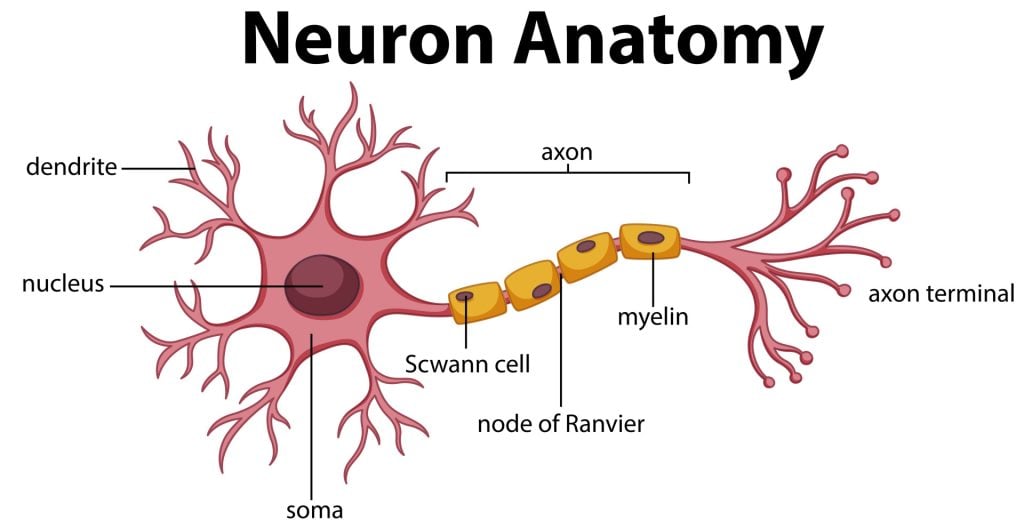 Diagram of Neuron Anatomy
The unique structure of neurons permits it to receive and carry messages to other neurons and throughout the body.
DendritesDendrites are the tree-root-shaped part of the neuron which are usually shorter and more numerous than axons. Their purpose is to receive information from other neurons and to transmit electrical signals to the cell body.Dendrites are covered in synapses, which allow them to receive signals from other neurons. Some neurons have short dendrites, whilst others have longer ones.For instance, cells called Purkinje cells, which arefound in the cerebellum, have highly developed dendrites to receive signals from thousands of other cells.
Dendrites
Dendrites are the tree-root-shaped part of the neuron which are usually shorter and more numerous than axons. Their purpose is to receive information from other neurons and to transmit electrical signals to the cell body.Dendrites are covered in synapses, which allow them to receive signals from other neurons. Some neurons have short dendrites, whilst others have longer ones.For instance, cells called Purkinje cells, which arefound in the cerebellum, have highly developed dendrites to receive signals from thousands of other cells.
Dendrites are the tree-root-shaped part of the neuron which are usually shorter and more numerous than axons. Their purpose is to receive information from other neurons and to transmit electrical signals to the cell body.
Dendrites are covered in synapses, which allow them to receive signals from other neurons. Some neurons have short dendrites, whilst others have longer ones.
For instance, cells called Purkinje cells, which arefound in the cerebellum, have highly developed dendrites to receive signals from thousands of other cells.
Soma (Cell Body)
The soma, or cell body, is essentially the core of the neuron. The soma’s function isto maintain the cell and to keep the neuron functioning efficiently(Luengo-Sanchez et al., 2015).
The soma contains a cell nucleus that produces genetic information and directs the synthesis of proteins. These proteins are vital for other parts of the neuron to function.
AxonThe axon, also called a nerve fiber, is a tail-like structure of the neuron that joins the cell body at a junction called the axon hillock.The function of the axon is tocarry signals away from the cell bodyto the terminal buttons to transmit electrical signals to other neurons.Acting as a conduit, the axon carries these signals to other neurons, muscles, or glands.
Axon
The axon, also called a nerve fiber, is a tail-like structure of the neuron that joins the cell body at a junction called the axon hillock.The function of the axon is tocarry signals away from the cell bodyto the terminal buttons to transmit electrical signals to other neurons.Acting as a conduit, the axon carries these signals to other neurons, muscles, or glands.
The axon, also called a nerve fiber, is a tail-like structure of the neuron that joins the cell body at a junction called the axon hillock.
The function of the axon is tocarry signals away from the cell bodyto the terminal buttons to transmit electrical signals to other neurons.Acting as a conduit, the axon carries these signals to other neurons, muscles, or glands.
 an illustration of a neuron with a focused section on the axon with its labelled parts
Most neurons have one axon, which can range in size from 0.1 millimeters to over 3 feet (Miller & Zachary, 2017). Some axons are covered in a fatty substance called myelin, which insulates the axon and aids in transmitting signals more quickly.
Axoplasm is the cytoplasm within an axon. It is responsible for transporting proteins, organelles, and other cellular components from the neuron’s cell body to the synaptic terminals and vice versa. This transport is crucial for the maintenance and function of the axon.
Myelin Sheath
The myelin sheath is a layer of fatty material that covers the axons of neurons. Its purpose isto insulateone nerve cell from another and toprevent the impulsefrom one neuron from interfering with the impulse from another.
The second function of the myelin sheath is to speed up the conduction of nerve impulses along the axon.
Myelin sheath is a fatty insulating layer surrounding the axons of many neurons. It accelerates electrical signal transmission and protects the axon.

The axons, which are wrapped in cells known asglial cells(also known as oligodendrocytes andSchwann cells), form the myelin sheath.
The myelin sheath that surrounds these neurons has the purpose of insulating and protecting the axon. Due to this protection, the speed of transmission to other neurons is a lot faster than the neurons that are unmyelinated.
The myelin sheath is made up of broken-up gaps called nodes of Ranvier. Electrical signals are able to jump between the nodes of Ranvier, which helps in speeding up the transmission of signals.
Axon Terminals
Located at the end of the neuron, the axon terminals (terminal buttons) are responsible fortransmitting signals to other neurons.
At the end of the terminal button is thesynapse. Terminal buttons hold vessels that contain neurotransmitters.
Neurotransmitters are releasedfrom the terminal buttons into the synapse and carry signals across the synapse to other neurons. The electrical signals convert to chemical signals during this process.
It is then the responsibility of the terminal buttons to reuptake the excess neurotransmitters that did not get passed onto the next neuron.
Types of Neurons
Although there are billions of neurons and vast variations, neurons can be classified into three basic groups depending on their function: sensory neurons, motor neurons, and relay neurons.
This illustration depicts the three primary types of neurons: sensory, interneuron, and motor. The sensory neuron is responsible for transmitting sensory information such as touch, sound, and light to the central nervous system. The motor neuron carries signals from the central nervous system to muscles and glands to initiate action. The interneuron is the vital link that transmits signals between sensory and motor neurons within the central nervous system, playing a key role in reflexes, learning, and other intricate processes.

Sensory Neurons
Sensory neurons (sometimes referred to as afferent neurons) are nerve cells that carry nerve impulses from sensory receptors toward the central nervous system and brain.
Sensory neurons have long dendrites and short axons.
When these nerve impulses reach the brain, they are translated into ‘sensations’, such as vision, hearing, taste, and touch.
This sensory information can be either physical – through sound, heat, touch, and light, or it can be chemical – through taste or smell. An example of this can be when touching an extremely hot surface. Once this happens, the sensory neurons will send signals to the central nervous system about the information they have received.
Most sensory neurons are characterized as being pseudounipolar. This means that they have one axon which is split into two branches.
Sensory neurons are nerve cells that transmit information from external and internal stimuli to the central nervous system for processing, allowing organisms to perceive sensations like touch, temperature, and pain.

Motor Neurons
Motor neurons(also referred to as efferent neurons) are the nerve cells responsible for carrying signals away from the central nervous system towards muscles to cause movement. They release neurotransmitters to trigger responses leading to muscle movement.
Motor neurons have short dendrites and long axons.
Motor neurons are located in the brainstem or spinal cord (parts of the central nervous system) and connect to muscles, glands, and organs throughout the body.
These neurons transmit signals from the spinal cord and brainstem to skeletal and smooth muscle to control muscle movements directly or indirectly.
For instance, after touching a hot surface with your hand, the sensory neurons receive the message. The motor neurons then cause the hand to move away from the hot surface.
There are two types of motor neurons:
Motor neurons are characterized as being multipolar. This means they have one axon and several dendrites projecting from the cell body.
Relay Neurons
A relay neuron (also known as an interneuron) allows sensory and motor neurons to communicate with each other. Relay neurons connect various neurons within the brain and spinal cord.
Relay neurons have short dendrites and short or long axons.
Alike to motor neurons, interneurons are multipolar. This means they have one axon and several dendrites.
The communication between interneurons assists the brain in completing complex functions such as learning and decision-making, as well as playing a vital role in reflexes and neurogenesis – which means theregeneration of new neurons.
References
Herculano-Houzel, S. (2009).The human brain in numbers: a linearly scaled-up primate brain.Frontiers in human neuroscience, 3, 31.
Luengo-Sanchez, S., Bielza, C., Benavides-Piccione, R., Fernaud-Espinosa, I., DeFelipe, J., & Larrañaga, P. (2015).A univocal definition of the neuronal soma morphology using Gaussian mixture models.Frontiers in neuroanatomy, 9, 137.
Miller, M. A., & Zachary, J. F. (2017). Mechanisms and morphology of cellular injury, adaptation, and death.Pathologic basis of veterinary disease, 2.
Further InformationNicholls, J. G., Martin, A. R., Wallace, B. G., & Fuchs, P. A. (2001). From neuron to brain (Vol. 271). Sunderland, MA: Sinauer Associates.Pereda, A. E. (2014). Electrical synapses and their functional interactions with chemical synapses. Nature Reviews Neuroscience, 15(4), 250-263.
Further Information
Nicholls, J. G., Martin, A. R., Wallace, B. G., & Fuchs, P. A. (2001). From neuron to brain (Vol. 271). Sunderland, MA: Sinauer Associates.Pereda, A. E. (2014). Electrical synapses and their functional interactions with chemical synapses. Nature Reviews Neuroscience, 15(4), 250-263.

 an illustration of a neuron with all the parts labelled including the axon, cell body, and dendrites
 Diagrams that illustrate the conduction of nerve impulses

Saul McLeod, PhD
BSc (Hons) Psychology, MRes, PhD, University of Manchester
Saul McLeod, PhD., is a qualified psychology teacher with over 18 years of experience in further and higher education. He has been published in peer-reviewed journals, including the Journal of Clinical Psychology.
Olivia Guy-Evans, MSc
BSc (Hons) Psychology, MSc Psychology of Education
Olivia Guy-Evans is a writer and associate editor for Simply Psychology. She has previously worked in healthcare and educational sectors.
