The persistent effort to manage time, stay organized, regulate emotions, and maintain focus can lead to a depletion of energy and motivation. As a result, people with ADHD may experience increased anxiety, depression, and a sense of hopelessness.
Burnout can manifest in various aspects of life, includingwork, school, and personal relationships, making it difficult for individuals to function at their best.
Recognizing the signs of ADHD burnout and understanding its causes are crucial steps in developing effective coping strategies and preventing the negative impact of chronic stress on overall well-being.

Signs of ADHD burnout
The signs of ADHD burnout may look and feel like an increase in the severity ofADHD symptoms. It may also look similar to the signs associated with depression, as individuals may become more sad, unmotivated, and apathetic.
Below are some of the common signs of ADHD burnout:
David Greenwood, ADHD author of the bookOvercoming Distractions: Thriving with Adult ADD/ADHDdescribes how burnout can cause sleep anxiety:
“Our sleep even gets worse… Not only less, but worse… I just would rehearse potential bad things at two in the morning and how I was going to deal with them.”
He explains that you may know that you still love that thing in your mind, but now your feelings are disconnected from it.
What causes ADHD burnout?
The signs of ADHD burnout may depend on what is causing the burnout. Below are some possible reasons why someone may be experiencing burnout.
Overcompensating
Overcompensation involves relentlessly trying to please others and meet expectations, even at the cost of personal well-being.
This need to constantly prove oneself can result in overexertion and burnout, as ADHDers push themselves beyond their limits in an attempt to counter deeply ingrained negative self-perceptions.
This overcompensating can look like trying to be neurotypical, known as “ADHD masking.“
She pushes herself to work weekends, assuming everyone else is doing the same without saying anything, in an attempt to hide her struggles and mask her ADHD symptoms, ultimately leading to burnout.
Overcommitting
Overcommitting is another common challenge for individuals with ADHD that can lead to burnout. Due to difficulties with time management, organization, and impulsivity, ADHDers may take on too many tasks or responsibilities without considering their own limitations or the time required to complete them.
For example, an adult with ADHD might agree to attend multiple social events in a single week, such as dinner parties, birthday celebrations, and community gatherings, while also promising to help friends with various projects like moving or renovating their homes.
This overcommitment stems from a desire to maintain friendships and avoid disappointing others, but it can quickly lead to feeling overwhelmed and unable to follow through on all of their commitments.
As the individual struggles to keep up with their packed social schedule and faces the consequences of overextending themselves, they may experience increased stress, anxiety, and feelings of guilt for letting others down.
This can strain relationships and contribute to social burnout, ultimately leading to a sense of exhaustion and a need to withdraw from social interactions to recharge.
Difficulty managing time and keeping organized
Challenges with time management and organization, linked toexecutive function deficits, can significantly contribute to ADHD burnout.
For example, a student with ADHD may have difficulty prioritizing tasks, meeting deadlines, completing homework on time, and managing their study time efficiently. As a result, they may experience a sense ofbeing overwhelmedand unable to cope with demands.
These feelings can occur daily and, over time, make individuals more susceptible to burnout because they have fewer mental resources to cope with their stress.
Emotional dysregulation
When faced with overwhelming situations, individuals with ADHD may experience heightened stress and emotional intensity, leading to mood swings andimpulsivity.
For example, when faced with a challenging work project, someone with ADHD may become increasingly frustrated and impulsively snap at people or want to give up.
As the situation persists, their ability toself-regulate emotions diminishes, depleting their coping resources and resulting in exhaustion and helplessness.
This can trigger a “shutdown” response, where the person withdraws from the task or situation to protect themselves from further emotional turmoil.
This overwhelming cycle can become repetitive, affecting daily functioning, work, school, and relationships, ultimately leading to burnout.
Procrastination
Procrastination is a common problem for people with ADHD. They often struggle with organizing, prioritizing, and controlling impulses, making it hard to start and finish tasks on time. This leads to last-minute rushes or forgetting to do important things altogether.
When procrastination becomes a long-term issue, it can seriously affect someone’s work, school, money, and relationships. Repeatedly failing to complete tasks can make people with ADHD feel depressed, anxious, ashamed, and self-critical.
Procrastination can have a negative impact on all parts of life for someone with ADHD, making their overall well-being and happiness worse. This ongoing struggle can eventually result in burnout.
Hyperfocus
Kristen Carder, an ADHD expert, explains that while hyperfocus may seem like a positive aspect of ADHD, it can actually contribute to burnout.
Hyperfocusis the ability to intensely concentrate on a task of interest, often to the exclusion of everything else.
However, as Carder points out, individuals with ADHD cannot control when they hyperfocus or easily switch it off. This can lead to neglecting important responsibilities, such as family obligations or self-care.
Moreover, hyperfocus often occurs after a period of procrastination, resulting in a frenzied attempt to complete the task.
The aftermath of hyperfocus can leave individuals with ADHD feeling emotionally and mentally drained for days.
Carder emphasizes that the inability to regulate hyperfocus and its potential to disrupt daily life can be debilitating, ultimately contributing to burnout in those with ADHD.
Undiagnosed ADHD
It is possible that those withundiagnosed ADHD may experience more frequent burnoutsthan those with a diagnosis.
Without an understanding that poor concentration, inattentiveness, and inability to adapt to complex job requirements are a result of ADHD, these individualsmay continue to feel frustrated and stressed, resulting in more burnouts.
Skye Rapsonexplains how, without an understanding that you may have ADHD, you may be stuck in a cycle of burning out and quitting jobs because ‘this career just isn’t for me – I think I need to go find a completely different career,’ but then you end up going through the same cycle at another job.
In contrast, individuals with diagnosed ADHD who receive proper treatment, such as stimulant medication and therapy, as well as workplace accommodations, may be able to manage their symptoms more effectively.
ADHD burnout cycle
The overwhelm-shutdown cycle is an emotional and behavioral pattern that individuals with ADHD may experience. The stages of this cycle can be described as follows:
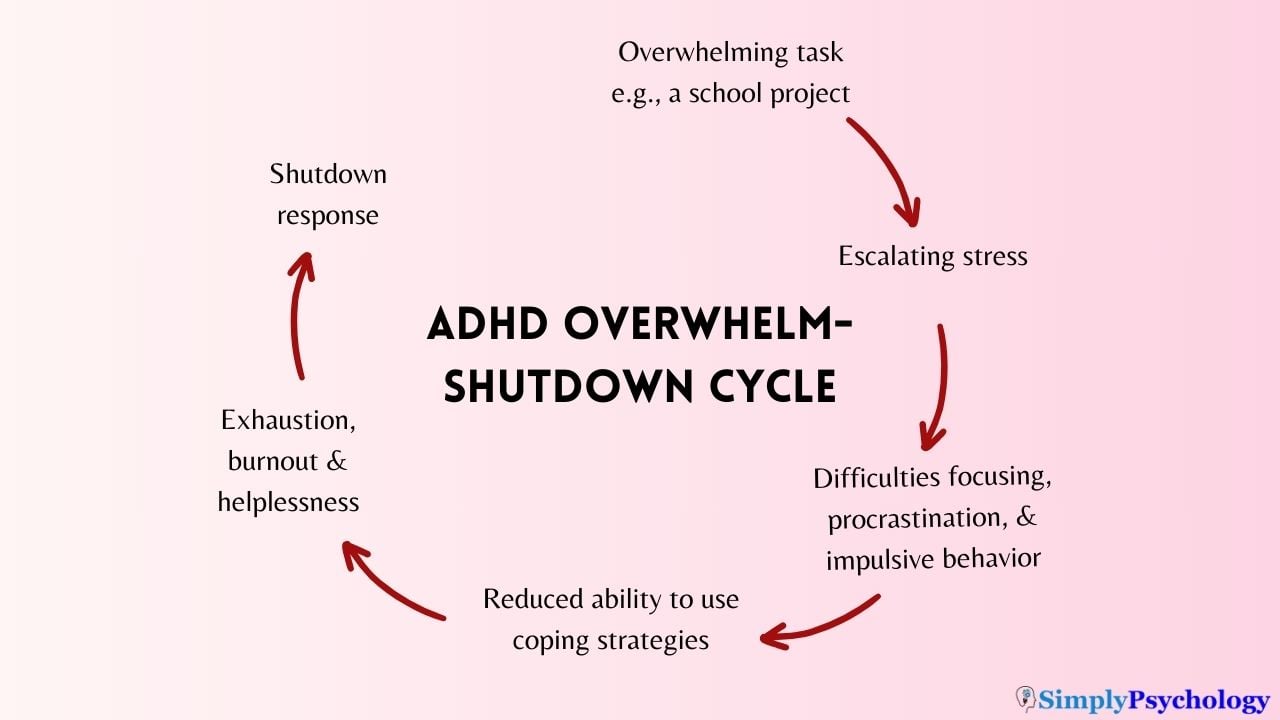
It’s important to recognize that this cycle can be challenging for individuals with ADHD to break, as the overwhelm and subsequent shutdown can reinforce feelings of inadequacy and make it harder to approach similar situations in the future.
ADHD burnout vs regular burnout
ADHD burnout is similar to regular burnoutbut with key differences.
ADHD burnout specifically stems from prolonged masking of ADHD symptoms and cognitive exhaustion from constantly fighting executive dysfunction.
Regular burnout typically results from chronic workplace or life stress, overwork, and emotional exhaustion, without the added layer of neurodivergent challenges.
ADHD burnout recovery and prevention
It can be difficult to leave a burnout state if you are already experiencing ADHD burnout, so prevention is often better. However, there are some ways in which to soothe a burnout so that recovery is quicker and the burnout is not extended.
Below are some ways in which toprevent and recover from ADHDburnout:
Next article
ADHD Burnout Recovery: 12 Tips
References
Tenev, V. (2024). Undiagnosed ADHD and Burnout Syndrome–is Untreated ADHD A Risk Factor for Burnout Syndrome.Inf J Neuropsy Beh Sci,5(1), 1-2.
Turjeman-Levi, Y., Itzchakov, G., & Engel-Yeger, B. (2024). Executive function deficits mediate the relationship between employees’ ADHD and job burnout.AIMS Public Health,11(1), 294.https://doi.org/10.3934/publichealth.2024015


Saul McLeod, PhD
BSc (Hons) Psychology, MRes, PhD, University of Manchester
Saul McLeod, PhD., is a qualified psychology teacher with over 18 years of experience in further and higher education. He has been published in peer-reviewed journals, including the Journal of Clinical Psychology.
Olivia Guy-Evans, MSc
BSc (Hons) Psychology, MSc Psychology of Education
Olivia Guy-Evans is a writer and associate editor for Simply Psychology. She has previously worked in healthcare and educational sectors.
